
The Anatomy of a Sacking: How a Lost Job Birthed East Africa’s Largest Private University
Christine Kiminta Kumomoru - MKU Student
In the early 1990s, a young, ambitious high school mathematics and chemistry teacher took a leap of faith. Simon Gicharu had secured a prestigious British Council scholarship to study in the United Kingdom. Driven by a desire to better himself, he boarded a plane, leaving behind his classroom in Kiambu County.
He expected to return as a more valuable asset to the Teachers Service Commission. Instead, he returned to a crushing reality: he had been summarily dismissed for traveling without official permission.
Unemployed, blacklisted from government teaching jobs, and with a young family to feed, Gicharu’s world collapsed. To survive, he bought an old, battered pickup truck and began delivering milk to local kiosks. It was a grueling, humbling comedown for a university graduate.
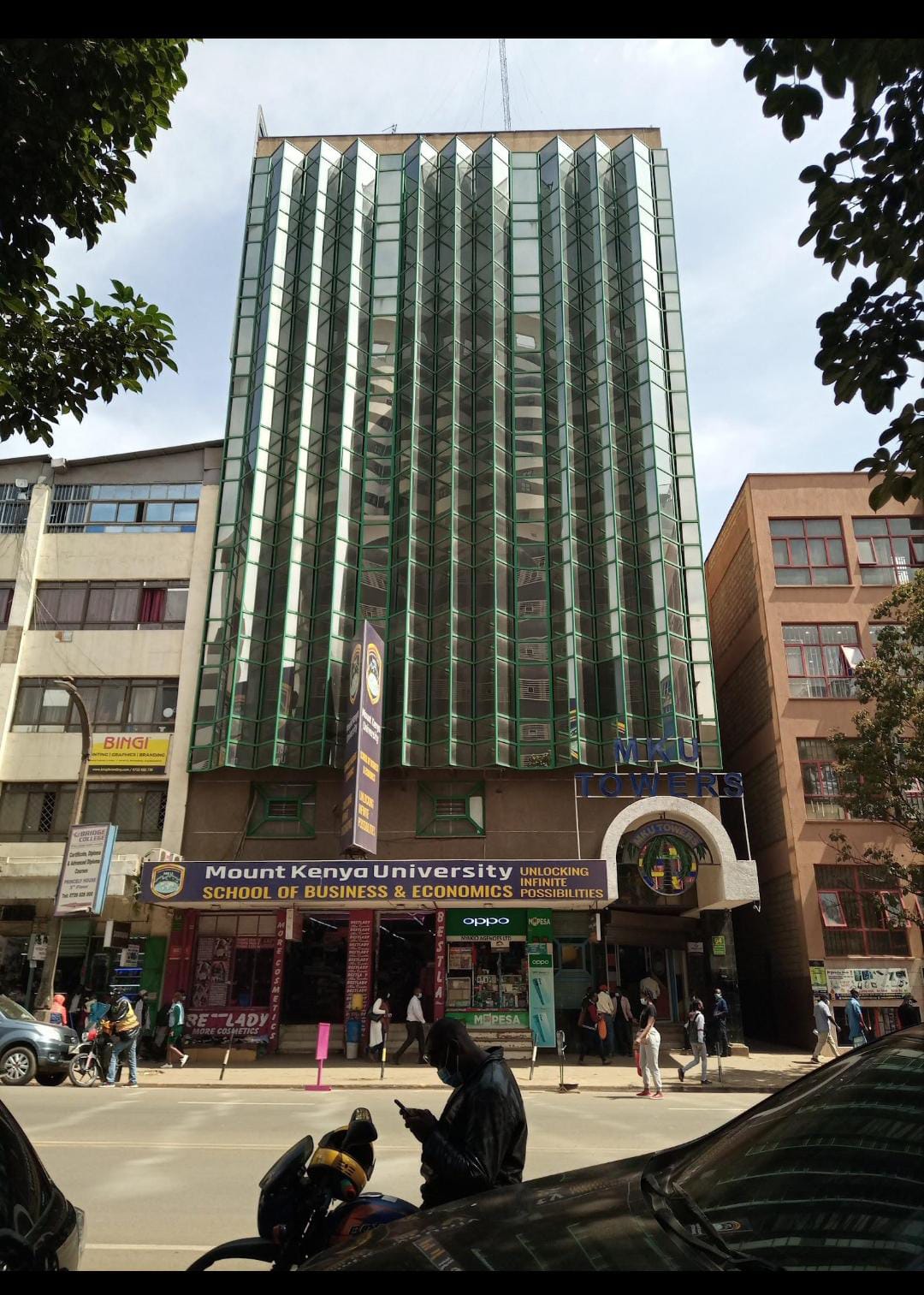
Yet, thirty years later, that same dismissed teacher would pull off one of the most astonishing corporate triumphs in East African history. In 2014, Gicharu shook the corporate landscape when he purchased the iconic Union Towers in Nairobi’s Central Business District from the family of former President Mwai Kibaki for a staggering Ksh 800 million.
Today, the building is known as MKU Towers the urban anchor of Mount Kenya University (MKU), a multi-billion-shilling academic empire hosting over 50,000 students across East Africa. Gicharu’s story is not just one of personal vindication; it is the blueprint for how modern private higher education was democratized in Kenya.
The road from the milk truck to the university chancellery began in 1996. Recognizing that the dawn of the internet was about to change the world, Gicharu gathered his meager savings and took a modest Ksh 20,000 loan from Equity Bank—then just a small building society.
He bought a handful of second-hand desks and launched a small NGO called the Computer Outreach Program in Thika. It was a risky bet at a time when computers were still luxury items in Kenya.
By 2000, the tiny program had outgrown its clothing and evolved into the Thika Institute of Management Studies (TIMS), which later became the Thika Institute of Technology (TIT). Gicharu’s strategy was simple yet revolutionary: offer affordable, practical, and flexible IT and management training to working-class Kenyans who could not afford or qualify for the rigid slots at public universities.
But Gicharu faced immense skepticism. In the early 2000s, private higher education was widely viewed as a playground for the wealthy elite or church-sponsored institutions. A self-made man from Kiambu trying to build a university from scratch was seen by many as an impossible dream.
Driven by a stubborn refusal to take “no” for an answer, Gicharu partnered with the Jomo Kenyatta University of Agriculture and Technology (JKUAT) in 2006 to offer validated diploma and degree programs. This move lent academic weight to his growing institution.
The ultimate validation came on May 30, 2008, when the government granted the institution a Letter of Interim Authority, officially constituting Mount Kenya University. Just three years later, in 2011, MKU was awarded a full University Charter by the government of Kenya.
The transformation from a tiny computer school with a few desks to a fully chartered university was complete. MKU rapidly expanded, building state-of-the-art labs, establishing a highly regarded School of Law in Parklands, and pioneering a medical school that challenged the dominance of traditional public institutions.
MKU’s growth did not stop at Kenya’s borders. Recognizing the post-conflict hunger for education in Rwanda, Gicharu expanded into Kigali in 2010. What started as a regional campus blossomed so successfully that it recently transitioned into a fully autonomous, independent entity: Mount Kigali University.
Back home, Gicharu’s empire continued to grow, expanding aggressively into Eldoret, Nakuru, Mombasa, and beyond. In an ironic twist of poetic justice, Gicharu later bought the building of a commercial college in Parklands that had once rejected his job application with the dismissive phrase, “Don’t call us, we’ll call you.”
Today, Prof. Simon Gicharu sits as one of Kenya’s most influential educational entrepreneurs and billionaires. Yet, those who know him say he has never quite forgotten the lessons learned behind the wheel of his old milk truck.
MKU’s massive success lies in its accessibility. By catering to evening, weekend, and virtual learners, it gave a generation of working professionals the chance to elevate their careers—a chance Gicharu himself was almost denied when he was sacked thirty years ago.
For aspiring entrepreneurs navigating the wreckage of a lost job or a failed venture, Gicharu’s journey stands as a monument to resilience. Sometimes, getting fired is not the end of a career; it is simply the rough, unexpected clearing where an empire begins.
